What Is the Most Famous Piece of Art in the World?
100 Most Famous Paintings In The Earth [Masterpieces Of Art]
Here are the tiptop 100 famous painters to ever exist and their masterpiece paintings.
Mona Lisa By Leonardo Da Vinci

Leonardo's Mona Lisa is one of the almost famous paintings in the earth. Today, it'southward housed at the Louvre in Paris, France merely it was created in Florence, Italy when Leonardo moved there to live from 1500-1508.Mona Lisa looks straight out at the states, the viewers, which was something unconventional for a portrait painting during that time.
The Starry Nighttime Past Vincent Van Gogh

Starry Night is one of the well-nigh recognized fine art pieces in the globe. Resonating with so many people effectually the world, it is a testament to its own originality which is timeless and universal.
The Birth of Venus by Sandro Botticelli

The painting showcases the nascency of the goddess Venus, arriving at the base aground, on the island of Republic of cyprus, conceived in a sea shell she is pushed by the breezes: Zephyr and, maybe, Aureola. The goddess is met by a young lady, who is in some cases is recognized as ane of the Graces or as the Hora of spring, and she holds out a shroud ready to encompass Venus.
Girl with a Pearl Earring by Johannes Vermeer

Vermeer's most well-known painting. Delineates a young lady, looking at her observer, in a yellow-brown dress, wearing an oriental turban, and an unrealistically huge pearl in her ear.
The Terminal Supper by Leonardo da Vinci

The Last Supper is a late fifteenth-century Christian painting done by the earth renowned Italian artist Leonardo da Vinci. It's housed at the Convent of Santa Maria Delle Grazie in Milan, Italy.
The Kiss by Gustav Klimt

The Kiss is a unique oil painting, which includes silver and gold leafs. It was painted between 1907 and 1908 during the time of Klimt's "Golden Period".
Las Meninas by Diego Velázquez
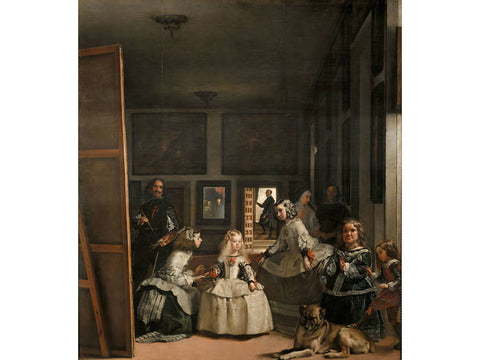
Las Meninas is a 1656 painting currently displayed at the Museo del Prado in Madrid. Diego Velázquez, was ane of the main artists of the Spanish Golden Historic period.
American Gothicby Grant Wood

American Gothic is a 1930 painting housed at the Art Found of Chicago. Wood was motivated to paint what is currently known as the American Gothic Business firm in Eldon, Iowa.
A Lord's day Afternoon on the Island of La Grande Jatte by Georges Seurat

A Dominicus Afternoon on the Island of La Grande Jatte was painted in 1884, and is Georges Seurat's almost renowned artwork. It brilliantly showcases the pointillist fashion. Seurat's composition incorporates various Parisians at a park center on the banks of the River Seine.
Guernica past Pablo Picasso

Guernica is an enormous oil painting that was finished in June 1937. It's presently displayed at the Museo Reina Sofía in Madrid. Parts of the painting where finished in Paris, where Picasso's had a domicile.
The Night Watch by Rembrandt

Local army Company of District II, under the Command of Captain Frans Banninck Cocq, otherwise chosen The Shooting Company of Frans Banning Cocq and Willem van Ruytenburch, is captured in The Dark Watch.
Café Terrace at Night by Vincent van Gogh

Café Terrace at Night is an 1888 oil painting by the famous Dutch artists Vincent van Gogh. It's often chosen, The Cafe Terrace on the Place du Forum. Furthermore, when information technology was originally displayed in 1891, information technology was titled Coffeehouse at Night.
Whistler's Mother by James Abbott McNeill Whistler

The Greyness and Black No.1, best known under the championship of Whistler's Mother, is an oil on canvass painting created by the famous American painter James McNeill Whistler in 1871. The subject of the work is Whistler'southward mom, Anna McNeill Whistler.
The Sleeping Gypsy by Henri Rousseau

The Sleeping Gypsy is a 1897 oil painting by the famous French artist Henri Rousseau. It is a fantastical delineation of a lion and a resting gypsy on a twilight night.
Bal du moulin de la Galette by Pierre-Auguste Renoir

Bal du moulin de la Galette is an 1876 painting by French creative person Pierre-Auguste Renoir. It is housed at the Musée d'Orsay in Paris and is one of the near renowned Impressionist pieces. The work of art portrays a sunday evening at the start Moulin de la Galette of Montmartre in Paris.
Impression, Sunrise by Claude Monet

Impression, Sunrise was showcased at what might exist considered the starting time impressionism, known as the "Brandish of the Impressionists" in Paris on April 1874. Impression, Sunrise delineates the port of Le Havre, close to Monet'south main residency.
The Third of May 1808 by Francisco Goya

The 3rd of May 1808 is a piece of work of fine art finished on 1814 by the Spanish painter Francisco Goya. The painting is presently at the Museo del Prado, Madrid. In the work, Goya recognizes the Napoleon's armed forces during the killing of 1808 in the Peninsular War.
Liberty Leading the People by Eugène Delacroix 
Liberty Leading the People is a piece of work by Eugène Delacroix celebrating the July Revolution of 1830, which toppled Male monarch Charles 10 of France.
Le Déjeuner sur l'herbe by Édouard Manet

Le Déjeuner sur l'herbe – initially titled Le Bain – is an enormous oil on canvas painting by Édouard Manet painted around 1863. Information technology delineates a female bare and 2 completely dressed men in a provincial setting.
Lady with an Ermine by Leonardo da Vinci

Lady with an Ermine is a work of fine art by Italian artist Leonardo da Vinci from around 1489–1490 and i of Poland's national fortunes. The field of study is Cecilia Gallerani, she was the lady of Ludovico Sforza, Knuckles of Milan, and Leonardo was in the Duke's administration.
The Raft of the Medusa past Théodore Géricault

The Raft of the Medusa – initially titled Scène de Naufrage – is an oil painting by the French Romantic painter and lithographer Théodore Géricault. It was finished when the creative person was 27, the piece of work became a symbol of French Romanticism.
Nighthawks past Edward Hopper

Nighthawks is a 1942 oil on canvas painting past Edward Hopper. It depicts individuals in a downtown java store tardily in the evening, seen through the burger joint's enormous glass window.
Tiffin of the Boating Political party by Pierre-Auguste Renoir

Dejeuner of the Boating Party is a work of fine art by French impressionist Pierre-Auguste Renoir. It was incorporated into the seventh Impressionist Exhibition in 1882, it was distinguished as the best painting in the show by three critics.
Napoleon Crossing the Alps by Jacques-Louis David
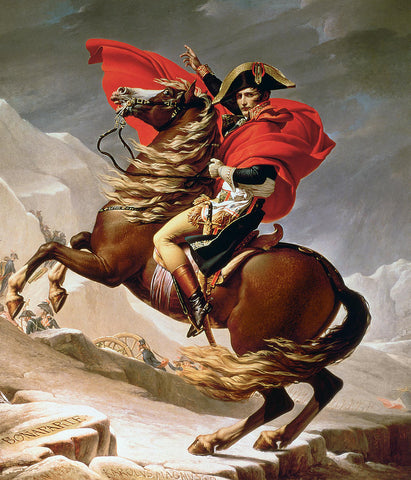
Between 1801 and 1805, the French creative person Jacques-Louis David painted a series of five oil on sheet horse portraits of Napoleon Bonaparte. The painting, which was deputed past the King of Spain, depicts a highly romanticized version of Napoleon's actual crossing of the Alps through the Great St Bernard Pass in May 1800. It has become one of Napoleon'southward virtually frequently reprinted photographs.
View of Toledo by El Greco
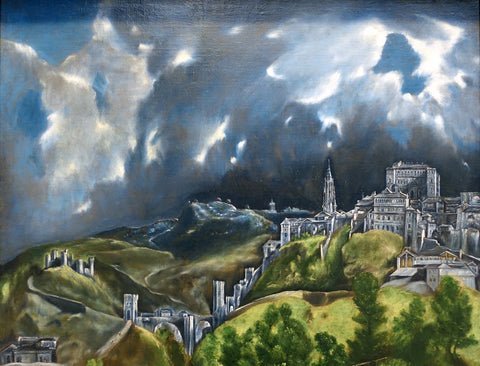
View of Toledo is one of the 2 enduring scenes painted past El Greco. The other, View and Programme of Toledo, is in plain view at the Museo de El Greco in Toledo.
Is a 1434 oil painting on wood panel by Jan van Eyck, an Early Netherlandish painter. It is idea to be a fulllength double portrait of Italian man of affairs Giovanni di Nicolao Arnolfini and his wife, likely in their home in the Flemish city of Bruges.
The Garden of Earthly Delights past Hieronymus Bosch

This fantastical triptych is ordinarily viewed as a far off herald to Surrealism. In truth, information technology's the statement of a belatedly medieval artist who accustomed that God and the Devil, Heaven and Hell were genuine. Of the three scenes delineated, the left board demonstrates Christ showing Eve & Adam.
Les Demoiselles d'Avignon by Pablo Picasso

Is a big oil piece of work by the Castilian creative person Pablo Picasso, completed in 1907. The painting, which is part of the permanent drove of the Museum of Modern Art, depicts v naked female person prostitutes at a brothel on Barcelona's Carrer d'Avinyó (Calle de Avión [es]). None of the figures are conventionally feminine, and each is depicted in an unsettling aggressive manner.
The Naked Maja by Francisco de Goya y Lucientes

Certainly OK with herself, this female naked gazing unashamedly at the watcher created a pregnant ruckus when information technology was painted, and even got Goya into high temp water with the Spanish Inquisition. In addition to other things, information technology highlights one of the chief portrayals of open hair in Western fine art. Dispatched by Manuel de Godoy, Kingdom of spain's Prime number Minister, The Naked Maja was joined past another accommodation with the sitter dressed. The personality of the lady stays a hole-and-corner, however, she is believed to exist Godoy's special lady, Pepita Tudó.
The Creation Of Adam by Michelangelo

The Creation of Adam is without a incertitude the one piece which has most profoundly dazzled visitors. No big surprise, for here we are given an overpowering vision of of God. Information technology depicts how God made Adam from the residue of the world. This story is never delineated actually in Renaissance art.
Nude Descending a Staircase, No. 2 by Marcel Duchamp

A complex blend of Cubism and Futurism, Duchamp'southward delineation of the primary subject in unlike presentation brings out evolution through time just as space and was roused by the photographic move investigations of Eadweard Muybridge and Étienne-Jules Marey. Nude was one of a bunch of paintings Duchamp fabricated before turning full time towards the conceptualist works.
Grande Odalisque past Jean Auguste Dominique Ingres

Authorized by Napoleon'southward sis, Queen Caroline Murat of Naples, Grande Odalisque spoke to the creative person'south pause with the Neo-onetime style he'd been related to for quite a bit of his profession. The work could be depicted equally Mannerist, all the same, it's, for the most role, thought of as a change to Romanticism, a evolution that renounced Neo-classicalism's exactness, convention, and equipoise. This depiction of a mistress is anatomically off base of operations, this cryptic, uncanny effigy was welcomed with sneers by pundits at the time, however, information technology, in the end, wound up 1 of Ingres' almost renowned works.
Wanderer above the Ocean of Fog past Caspar David Friedrich

Wanderer To a higher place The Sea Of Fog Assay
Wanderer above the Sea of Fog is a painting by Caspar David Friedrich, a High german Romantic artist, painted in 1818. It is regarded every bit i of the greatest works of Romanticism and 1 of its most emblematic works. The artwork is on display in Hamburg, Germany, at the Hamburger Kunsthalle.
The Swing by Jean-Honoré Fragonard

Jean-Honoré Fragonard'due south The Swing was basically a commission given to him by another painter Gabriel-François Doyen. The painting'southward storyline and the arrangement was proposed to Doyen by a courteous fellow of the court, who needed a painting of him and his fancy adult female.
A Cotton wool Office In New Orleans by Edgar Degas

This painting depicts his uncle's cotton financier business when information technology failed during a monetary blow. Here, Degas' Uncle, Musson, is seen grabbing the nature of crude cotton fiber, while Degas' sibling Achille is leaning confronting a window at the left. His sibling Rene is perusing a newspaper while a few other individuals approach them.
Irises past Vincent van Gogh

Irises is 1 of several paintings of irises by the Dutch creative person Vincent van Gogh, and one of a sequence of works he completed in the last year of his life at the Saint Paul-de-Mausole asylum in Saint-Rémy-de-Provence, France.
A Bar at the Folies-Bergère by Édouard Manet

Édouard Manet's painting A Bar at the Folies-Bergère is regarded to be his terminal big work. It was painted in 1882 and displayed at the Salon de Paris the same year. Information technology depicts a scene from the Paris nightclub Folies Bergère. One of the prostitutes is supposed to exist represented past the woman behind the bar. Suzon, a genuine person who worked at the cafe-concert hall in the early 1880s, was a real person.
Limerick viii by Wassily Kandinsky

Wassily Kandinsky's Limerick Viii is an oil-on-canvass painting in the Abstract style that he painted in 1923. The painting features a diverseness of geometric patterns, colors, and straight and curved lines confronting a foam backdrop that blends into areas of pale blue at certain points. Circles, triangles, and linear pieces form a surface of interlocking geometric forms in this painting. The prominence of circles in this painting foreshadows their central significance in many post-obit works.
The Scream by Edvard Munch

The Scream is the famous name for a composition past Norwegian artist Edvard Munch, which was produced in 1893. The painting'south pained face has become one of the most iconic images of art, expressing the human condition'south angst.
Paris Street In Rainy Atmospheric condition by Gustave Caillebotte

Gustave Caillebotte's all-time-known work, Paris Street; Rainy Day, is a massive 1877 oil painting by the French artist Gustave Caillebotte. It depicts a grouping of people going through the Place de Dublin, then known equally the Carrefour de Moscou, in north Paris, at a crossroads east of the Gare Saint-Lazare.
Boreas by John William Waterhouse

Boreas is the Greek god of the north wind, and the artwork depicts a young girl existence buffeted past the wind. A daughter goes through a bound scene accentuated by pink flower and daffodils, according to the 1904 Royal Academy notes: In current of air-diddled drapery of slate-colour and blueish, a girl walks through a bound landscape accented by pinkish blossom and daffodils.
Branches with Almond Blossom by Vincent van Gogh

Almond Blossoms is a collection of paintings of blossoming almond trees painted by Vincent van Gogh in Arles and Saint-Rémy, southern France, betwixt 1888 and 1890. Van Gogh was specially fond of flowering copse. They symbolized rebirth and hope. He liked the way they looked and enjoyed cartoon blossoming trees.
Lady Godiva by John Maler Collier

Lady Godiva is an 1897 painting by John Collier, an English language artist who painted in the Pre-Raphaelite Brotherhood style. Lady Godiva and her well-known but mythical ride through Coventry, England, are depicted in the Herbert Art Gallery and Museum in Coventry. Thomas Hancock Nunn, a social reformer, bequeathed Lady Godiva. The work was offered to the Corporation of Hampstead after he died in 1937. In his will, he said that if Hampstead declined his heritance, the work would be presented to Coventry. Mab (Mabel) Paul, an artist model and W End phase actress who was too painted as herself past John Collier, is the model in the painting.
Salvator Mundi by Leonardo da Vinci

Salvator Mundi is a piece of work ascribed in whole or in part to Leonardo da Vinci, an Italian High Renaissance artist who lived between 1499 and 1510. It was recovered, restored, and exhibited in a major exhibition of Leonardo'south work at the National Gallery in London in 2011–2012, long assumed to be a duplicate of a lost original veiled in overpainting. The artwork depicts Christ in an anachronistic blueish Renaissance gown, clutching a transparent, not-refracting crystal ball in his left hand, marking his office as Salvator Mundi and representing the 'celestial sphere' of the skies, while making the sign of the cantankerous with his right manus.
Champ de Mars: The Blood-red Belfry by Robert Delaunay

In the wintertime of 1912, the artist originally exhibited this painting at the Galerie Barbazanges in Paris, where Guillaume Apollinaire described it as "unfinished, whether past intention or accident" in a review. Delaunay painted a series of Eiffel Tower paintings, ane of which is on display at the Fine art Institute of Chicago. Multiple views, rhythmic fragmentation of form, and dramatic colour contrasts were employed by the artist to convey the vitality of modern life in this artwork. Delaunay emphasized the structure's colossal size by framing it with tall buildings and placing smaller, shorter buildings at its base of operations, which could be viewed from in a higher place.
Among the Ruins past Sir Lawrence Alma-Tadema

Alma-Tadema was i of the about well-known Victorian artists. Though praised for his draftsmanship and portrayals of Classical artifact during his lifetime, his work savage out of favor afterwards his decease, and it has just been re-evaluated for its significance in nineteenth-century British fine art since the 1960s.
Color Study, Squares with Concentric Rings by Wassily Kandinsky

Kandinsky painted this vibrant, colorful work to experiment with the result of putting different hues side by side to each other. He wanted to know which colors stand out and which alloy in, as well as how to mix different colors to brand a vibrant, appealing pattern. He paints concentric circles within each square unit, which means the circles all take the same central point. He utilized the circle as an abstract form because he believed information technology had symbolic pregnant in relation to the secrets of the cosmos. The artwork is energized past the contrast of highly saturated, bright hues.
Stag Night At Sharkeys by George Bellows

George Wesley Bellows painted Stag at Sharkey's in 1909, representing two boxers battling in the sectional sports social club opposite from his studio. Information technology's part of the Ashcan School movement, which is notable for showing images of everyday life in early twentieth-century New York City, particularly in the urban center'southward poorer areas. Members of the guild were generally in the boxing band, simply outsiders with temporary memberships would occasionally fight. Stags were the proper noun given to these fighters.
The Great Wave Off Kanagawa by Katsushika Hokusai

The Great Wave off Kanagawa, oft known as The Bang-up Wave or The Moving ridge, is a Japanese ukiyo-e artist Hokusai'due south woodblock print. It was the first print in Hokusai's series Thirty-six Views of Mount Fuji, which was completed in 1831 during the tardily Edo menstruation. With fully saturated blues and exceptional contrast, The Nifty Wave is a visually spectacular piece of work.
Interchange by Willem de Kooning

Willem de Kooning's abstract expressionist oil painting Interchange, too known as Interchanged, is an abstract expressionist oil painting on sail by the Dutch-American painter. De Kooning, similar Jackson Pollock, was a pioneer of the abstract expressionism move, the first American modern fine art tendency. Its dimensions are 200.7 centimetres past 175.3 centimetres.
Breezing Up also known as A Off-white Air current by Winslow Homer

Breezing Upwards (A Fair Wind) is an oil painting by Winslow Homer, an American artist. It shows the Gloucester, a catboat, cruising through the harbor of that city in "a pleasant current of air" (Homer's original championship). A dad, three lads, and their catch are aboard the boat. The artwork was completed in 1876, and it was first shown at the National Academy of Blueprint that year, followed by the Centennial Exposition in Philadelphia. Past 1879, information technology was known every bit Breezing Upwardly, a moniker that did non belong to the artist but that he did not appear to heed. "It is painted in [Homer'southward] normal crude and negligé style, withal represents with obvious intensity the life and motion of a breezy summer day off the declension," a contemporary critic wrote.
Wheat Field with Cypresses at the Haude Galline well-nigh Eygalieres past Vincent van Gogh

A Wheatfield with Cypresses is one of three wheat field works by Vincent van Gogh, all of which date from 1889 and are office of his wheat field series. Van Gogh was voluntarily a patient at the Saint-Paul-de-Mausole mental institute in Saint-Rémy near Arles, France, from May 1889 to May 1890, when he showed all of his works.
A Friend In Need past Cassius Marcellus Coolidge
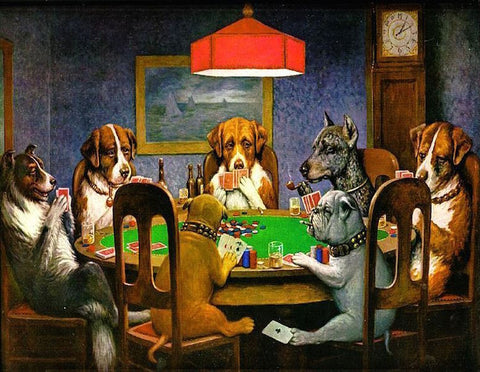
Cassius Marcellus Coolidge'due south A Friend in Need is as well known as Dogs Playing Poker. One of a set of 16 paintings created in 1910. This is ane of the most well-known, and information technology'southward fifty-fifty been featured in the Simpsons. The dogs are playing poker with their pals while smoking cigars and sipping whiskey.
Boulevard des Capucines by Claude Oscar Monet

Boulevard des Capucines is an 1873 oil on canvas street scene painting past French Impressionist artist Claude Monet of the famed Paris boulevard. Monet used the Japanese mobile viewpoint in Boulevard des Capucines to encapsulate the bitty, yet mod civilized experiences of space equally the eye plunges into the deep channel of the decorated sidewalk, seeking to disentangle the clues to the circuitous visual experiences provided by a myriad detached brushstrokes.
Dancers Bending Downwardly, also known every bit The Ballerinas by Edgar Degas

Dancers Angle Downwardly, too known equally The Ballerinas, is a classic artwork by French artist Edgar Degas, which was produced in 1885. This masterwork is now endemic past a private drove, which ways nosotros will have less opportunities to see Edgar Degas' painting in person. The pastel drawings of dancers past Degas are among his best-known works. Many of the works, notably The Star (1878), use arcadian compositions, frantic sketching, and rich color backdrops to convey the spectacle of the ballet.
Dante And Virgil In Hell by William-Adolphe Bouguereau

Dante and Virgil is an 1850 oil on sail work past William-Adolphe Bouguereau, a French academic painter. The Musée d'Orsay in Paris has it on exhibit. The work represents a scene from Dante'southward Divine Comedy, which depicts Dante and his companion Virgil on a voyage through Hell. The author and his guide are watching every bit 2 tormented souls are entwined in unending conflict in the scene. Capocchio, an alchemist and heretic, is one of the souls. Gianni Schicchi, the trickster who had used trickery to steal another man'due south inheritance, bites him on the neck.
Carnation, Lily, Lily, Rose by John Singer Sargent

Carnation, Lily, Lily, Rose is an oil-on-sail work by John Singer Sargent, created between 1885 and 1886. The artwork depicts 2 tiny children clothed in white burning paper lanterns in a garden littered with pink roses, yellow carnations, and tall white lilies (mayhap the Japanese mountain lily, Lilium auratum) backside them as the mean solar day changes to nighttime. Green leafage dominates the artwork, which lacks a horizon or other horizontal line to provide a sense of depth. The viewer appears to exist on the same level as the kids, but he or she is too looking down on them. The painting'due south two protagonists are the daughters of Sargent'south friend and illustrator Frederick Barnard. The piece of work is situated in an English language garden at Farnham House almost Broadway, in the Cotswolds, where Sargent spent the summer of 1885 with Millet after fleeing the scandal surrounding his 1884 masterpiece Portrait of Madame X.
When Will You Marry? by Paul Gauguin

When Will You Marry? is an 1892 oil painting past Paul Gauguin, a French Post-Impressionist artist. In 1891, Gauguin visited Tahiti for the commencement fourth dimension. Rather than the primitivist fake works being produced by artists in France, he hoped to establish "an edenic paradise where he could make true, 'primitive' art."
The Adjuration Of Horatii by Jacques-Louis David

The Oath of the Horatii is a big artwork by Jacques-Louis David that was completed in 1784 and is presently on exhibit in the Louvre in Paris. The painting was an instant hitting with critics and the general public, and information technology is even so one of the most well-known Neoclassical works. It depicts a scene from a Roman tale about a feud between two warring cities, Rome and Alba Longa, in the seventh century BC, and emphasizes the significance of patriotism and masculine self-sacrifice for one's nation.
Flaming June past Frederic Leighton

Sir Frederic Leighton's work Flaming June was completed in 1895. It is widely regarded as Leighton's magnum effort, showing his classicist nature and painted with oil paints on a 47-by-47-inch square canvas. The creative person was interested in exploring the aesthetic relationship between slumber and death, which was a popular theme among Victorian artists. Summer Slumber, ane of Leighton'due south other works, used Flaming June every bit a motif to embellish a marble bath. He grew so enamored with the blueprint that he decided to turn it into a carve up painting.
Annunciation by Leonardo Da Vinci

The Annunciation is a work credited to Leonardo da Vinci, an Italian Renaissance creative person who lived between 1472 and 1476. The oldest existing major piece of work past Leonardo, it was created in Florence while he was an apprentice in Andrea del Verrocchio'southward studio. The piece of work's discipline content is taken from Luke 1.26–39. It represents the angel Gabriel telling Mary that she would pregnant miraculously and requite birth to a son who would be known as "the Son of God" and whose dominion would last forever. The Proclamation was a popular bailiwick for contemporaneous artworks painted in Christian countries like Italy, and it had been shown numerous times in Florentine art, including multiple instances by the Early on Renaissance painter Fra Angelico.
The Avenue In The Rain past Childe Hassam

The Artery in the Rain is an oil painting by Childe Hassam, an American Impressionist painter, from 1917. It depicts Fifth Artery in New York City in the rain, with American flags draped across it. The artwork is 1 of half dozen past Hassam in the White Firm'southward permanent art collection in Washington, D.C. Hassam painted roughly xxx paintings of flag-draped streets between 1916 and 1919. This work was completed in February 1917, when the flag had 48 stars and the United States was nearly to enter the Outset World War, at a time when nationalist pride was loftier. Germany had extended its armed forces assailment to neutral ships, including American ships, the previous month. The Zimmermann Telegram was fabricated public at the cease of February 1917, and on Apr 6, 1917, the country declared war on Germany.
Dance at Bougival by Pierre Auguste Renoir

Pierre-Auguste Renoir's Dance at Bougival is a painting from 1883 that is currently housed in the Museum of Fine Arts in Boston, Massachusetts, Us. It is one of three works in a group commissioned by Paul Durand-Ruel and described as "ane of the museum'southward most beloved works." Two dancers are seen in the painting, who are surrounded past a vibrant scene of café patrons. Although the painting's exact subjects are debatable, it is well renowned for conveying the idea that they are moving, giving the viewer the impression that they are there. Renoir employed largely pastel hues, although the hats of both subjects had a more vivid tone. Renoir's last journeying into Impressionism, to which this work belongs, is described as demonstrating the progression of his creative talent from his previous works.
Nonetheless Life with Irises by Vincent van Gogh

Van Gogh produced a sequence of withal lifes in his final weeks at Saint-Rémy before returning north. The grandeur and scale of these harken back to the enormous Sunflowers painting from the summer of 1888, but the controlled utilize of complimentary hues also harkens back to the color and flower painting efforts that consumed him during his first yr in Paris, 1886. Van Gogh painted pink flowers confronting a green groundwork in Saint-Rémy, and violet irises against a yellow background hither. The artwork exudes a new sense of vitality and color intensity. Instead of softening the contrasts to balance the various elements of the work, as he sometimes did, Van Gogh has endeavored to sharpen and enhance them here, every bit he had done in Paris.
Boxing Of Issus by Albrecht Altdorfer

Albrecht Altdorfer a forerunner of landscape art and a co - founder of the Danube school, painted The Battle of Alexander at Issus in 1529. The Battle of Issus, which took place in 333 BC, was a critical victory for Alexander the Cracking over Darius 3 of Persia, giving him crucial leverage in his boxing against the Western farsi Empire. The piece of work is normally recognized every bit Altdorfer's masterpiece, and it is 1 of the well-nigh famous instances of the global mural, a genre of Renaissance landscape painting that reaches extraordinary grandeur here.
The Lady Of Shalott by John William Waterhouse

The Lady of Shalott is an 1888 artwork by John William Waterhouse, an English painter. Information technology's a recreation of the same-named poem by Alfred, Lord Tennyson, written in 1832. In 1888, 1894, and 1915, Waterhouse painted iii different renditions of this character. Waterhouse painted several decades afterwards the Pre-Raphaelite Brotherhood split upward during his early infancy, and information technology is ane of his most famous works, adopting much of their style. Sir Henry Tate presented the Lady of Shalott to the public in 1894, and it is currently on exhibit in room 1840 of Tate Britain in London.
The Boat Trip past Mary Cassatt

The flat, patterned surfaces, reduced color, and strange angles of Japanese prints, which were pop in Paris in the late 1800s, are evident in this dramatic composition. The subject is compressed onto the flat surface of the canvas by the dark effigy of the guy, and the horizon is pushed to the top, burdensome a sense of distance. Nosotros have an oblique view into the boat from our college vantage point. The junction of its horizontal supports divides its form into ornamental shapes. Cassatt's first solo exhibition in the United states in 1895 featured this piece of work, which was one of her well-nigh ambitious. Her relationships with rich people in the The states were instrumental in bringing avant–garde French painting to the United States.
Boulevard Montmartre Spring past Camille Pissarro

Pissarro's technique to the systematic examination of a number of views of the same discipline is revealed in the Boulevard Montmartre series, which has a remarkable scope and variety. The artist examined the many climatic conditions of the street while focusing on a unmarried compositional element - the imperial procession of the Boulevard Montmartre.
Sailboat at Le Petit-Gennevilliers past Claude Oscar Monet

Claude Oscar Monet painted Sailboat At Le Petit Gennevilliers in 1874, that year he joined other present-day artists to relocate to Paris.
Nu couché by Amedeo Modigliani

Nu couché additionally referred to in English as Red Nude or Reclining Nude is a 1917 oil on sheet painting past the Italian artist Amedeo Modigliani. It is one of his most more often than not replicated and displayed paintings. The painting sold for $170,405,000 at Christie'south New York auction on nine Nov 2015.
The Dark Buffet past Vincent van Gogh

The painting was executed on a modernly prepared canvas of size thirty (French standard). Information technology delineates the inside of the bistro, with a half-curtained entryway. Five clients sit down at tables and at that place is a billiard table close to the focal point of the room.
The Woman with a Parasol by Claude Oscar Monet

Claude Monet's oil-on-sail painting Woman with a Parasol – Madame Monet and Her Son, also known as The Stroll, was completed in 1875. The Impressionist painting features his married woman Camille Monet and their son Jean Monet during their fourth dimension in Argenteuil, from 1871 to 1877, capturing a moment during a promenade on a windy summer twenty-four hour period.
A Moorish Bath (likewise known every bit Turkish Woman Bathing) by Jean-Léon Gérôme

Jean-Léon Gérôme was a French painter and sculpture who worked in the academicist style. By 1880, his paintings had been widely reprinted, making him "probably the globe's most famous living artist." Gérôme's paintings were frequently misrepresented as genuine representations, hiding the artist'southward and artwork's roles in contributing to the Western ideological construct of the "Orient."
Portrait of Madame de Florian by Giovanni Boldini

During the Belle Époque, Marthe de Florian was a French demi-mondaine and socialite. Georges Clemenceau, Pierre Waldeck-Rousseau, Paul Deschanel, Gaston Doumergue, Robert de Montesquiou, and Giovanni Boldini were among her renowned lovers. Her narrative was resurrected in 2010 after her things were discovered unused for decades in her Parisian apartment, located at ii square La Bruyère in the 9th arrondissement.
The Beach at Trouville by Claude Oscar Monet

Monet blends conscious and unconscious via dissolving shapes, effacing identities, and dissolving forms. This work has sand on its surface, which was diddled on to the wet canvas every bit Monet worked in the open air on the embankment at Trouville in Normandy. The woman on the left is thought to represent Camille, Monet's first wife.
The Magic Circle by John William Waterhouse

The Magic Circumvolve is the title of 2 1886 oil paintings by John William Waterhouse in the Pre-Raphaelite fashion. A witch or sorceress draws a fire magic circle on the soil with her wand to create a ritual place for her ceremonial magic.
Masterpiece past Roy Lichtenstein

Roy Lichtenstein's Masterpiece is a 1962 pop art painting that has his signature Ben-Day dots and narrative information enclosed within a voice communication balloon. The work was sold for $165 one thousand thousand in 2017.
The Hireling Shepherd past William Holman Hunt

William Holman Hunt'southward painting The Hireling Shepherd is a Pre-Raphaelite masterpiece. It depicts a shepherd who neglects his flock in favor of a beautiful rural daughter, to whom he gifts a death's-head hawkmoth. The work's significance has been hotly contested.
The Belfry Of Babel past Pieter Bruegel the Elderberry

I of the three paintings by Pieter Bruegel the Elderberry draw the Belfry of Babel. The first, a miniature painted on ivory that was painted while Bruegel was in Rome and is at present lost, was painted while Bruegel was in Rome. The ii surviving paintings, oftentimes referred to as "Bully" and "Little," are housed in Vienna's Kunsthistorisches Museum and Rotterdam's Museum Boijmans Van Beuningen, respectively. Both paintings are oil on woods panels. The paintings represent the construction of the Tower of Boom-boom, which, co-ordinate to the Bible's Book of Genesis, was built as a symbol of humanity'southward triumph by a unified, monolingual humanity.
The Gleaners by Jean-Francois Millet

Jean-François Millet's oil work The Gleaners (Des glaneuses) was created in 1857. It shows three peasant ladies after the harvest gleaning a field of stray wheat stalks. The artwork is noteworthy for depicting what were once the lowest sections of rural society in a sympathetic light; it was not well welcomed by the French upper classes. In 1857, Millet debuted The Gleaners at the Salon. It drew quick ire from the middle and upper classes, who regarded the discipline with distrust.
The Card Players by Paul Cézanne
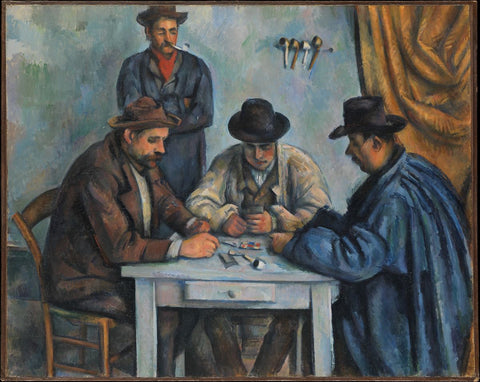
The Bill of fare Players is a serial of oil paintings by Paul Cézanne, a French Postal service-Impressionist painter. There are five works in the series, all painted during Cézanne'south last era in the early 1890s. The game's size, number of players, and setting all differ betwixt versions. In grooming for The Menu Players series, Cézanne fabricated various drawings and studies.
Fishing boats on the Beach at Les Saintes-Maries-de-la-Mer by Vincent van Gogh

The boats are constructed up of color-coordinated regions with distinct outlines. The boats also don't cast any shadows on the shore. Van Gogh was familiar with these style aspects from his collection of Japanese prints. Van Gogh would have loved to pigment this on the shore, simply he was unable to do so since the fishermen set sail very early every morning time. He did, all the same, draw the boats at that place and later painted this artwork at dwelling house.
A Wooded Path In Autumn past Hans Andersen Brendekilde

A Wooded Path in Fall is a delightful painting past Hans Andersen Brendekilde. Hans Andersen was a Danish painter who came for a poor family unit. As a youngster, he was apprenticed be an artist.
Spanish Dancer by John Singer Sargent

El Jaleo is a huge painting past John Singer Sargent, delineating a Spanish Gypsy artist performing. The painting was motivated by a five-month trip Sargent made through Spain and North Africa in 1879.
A Mermaid by John William Waterhouse
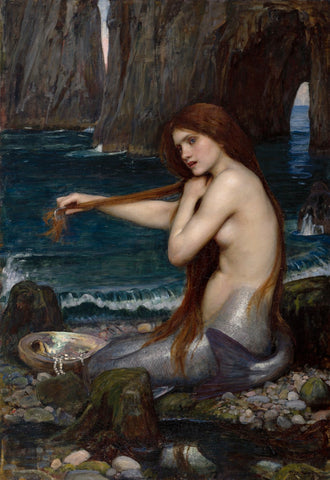
Waterhouse was likewise intrigued by the folklore of the mermaid sorcerer. Mermaids more often than not baited mariners to their demise through their enrapturing tune.
The Orange Trees by Gustave Caillebotte

The work incorporates all of the essential characteristics of modern art. According to the Impressionist canon, the sundrenched work, with the almost felt summer heat emanating off the garden path, was most likely painted outside. Caillebotte's goal to represent a transitory moment—that time before the light changes and the feeling of delightful peace and repose is disrupted—is reflected in the brief, sketchy brushstrokes.
Summer Evening at Skagen by Peder Severin Kroyer

Peder Severin Kryer's painting Summer Evening on Skagen's Southern Beach is considered one of his finest. Kryer was one of the well-nigh well-known members of the Skagen Painters, a group of Danish artists. Kryer's works oftentimes emphasize the Skagen low-cal's distinctive furnishings, including numerous notable works representing beach scenes. The artwork was inspired by Anna Ancher and Marie Kryer's walk along the beach following a dinner party at the Kryers' domicile in the summer of 1892, when the guests went downwards to the shore to bask the wonderful evening.
The Siesta by Paul Gauguin

The Siesta is a Paul Gauguin oil on canvas painting from 1892-1894 that is presently housed in the Metropolitan Museum of Art in New York. During Gauguin's first extended journey to Tahiti, he painted this painting.
The Nascence of Venus by Alexandre Cabanel

The Birth of Venus is a painting by Alexandre Cabanel, a French artist. Information technology was painted in 1863 and is shortly housed in Paris's Musée d'Orsay. The Dahesh Museum of Art has a second, smaller replica from around 1864. A tertiary version, dating from 1875, can be found in New York City'southward Metropolitan Museum of Art.
Dance Form by Edgar Degas

Edgar Degas painted The Dance Class in 1874. Information technology is in the Metropolitan Museum of Fine art'due south collection. The painting, together with a sister piece in the Musée d'Orsay in Paris, is i of Degas' most all-encompassing works on the subject field of ballet.
The Osculation by Francesco Paolo Hayez

The Buss is an 1859 painting past Francesco Hayez, an Italian artist. Information technology's his most well-known piece. This artwork captures the essence of Italian Romanticism and has come to symbolize the Risorgimento mental attitude. Alfonso Maria Visconti di Saliceto commissioned information technology and presented it to the Pinacoteca di Brera following his death.
Repeat and Narcissus by John William Waterhouse

John William Waterhouse painted Echo and Narcissus in 1903. It depicts the Ovid's Metamorphoses story of Echo and Narcissus. John William Waterhouse was an English language painter who was categorized as a Pre-Raphaelite considering of his style and topics. He created near 200 works, mostly in the disciplines of classical mythology, history, and literature. The femme fatale, or the woman who ensnares a human, is 1 of his recurring motifs.
Dempsey and Firpo, besides known as Brodie's Revenge by George Wesley Bellows

One of George Bellows' nearly elaborate paintings, Dempsey and Firpo, depicts a cardinal moment in the championship bout between American heavyweight champion Jack Dempsey and his Argentine rival Luis Angel Firpo on September 14, 1923. Firpo dropped to the ground ix times and Dempsey twice during the frenzy, which lasted less than four minutes. Despite the fact that Dempsey won in the end, the creative person chose to depict the dramatic moment when Firpo knocked his opponent out of the ring with a massive jaw hit.
Oarsmen by Gustave Caillebotte

Two guys in conventional boating wearing apparel, jerseys, and straw hats row in a solid boat; 1 man's face is obscured while the other's is only barely drawn, forcing the observer to focus on the two pairs of arms, symbols of labor and motion. The artist'south perspective is about someone standing in the boat or looking down from a bridge, enabling for a plunging, arrowlike configurational scheme, moderated to some extent past the horizontal lines of the oars, the front rower's seat, likewise as the splashing wavelets, but a few of which are affected past the hull's advance.
The Abduction of Psyche by William Bouguereau

Cupid is shown embracing Psyche in a passionate encompass as he transports her to the Otherworld to go his married woman in the picture show. The newly emerged butterfly wings of Psyche are symbolic, indicating her immortality. Her pliant figure appears soft and vulnerable, and her facial expression is 1 of blissful happiness. Cupid's arms encircle Psyche, implying possession, while Psyche'southward posture suggests utter surrender.
Patroclus by Jacques-Louis David

Patroclus is a modest painting past Jacques Louis David, a Neo-classicist painter who created information technology in 1780. It is now part of the Musée Thomas Henry's collection in Cherbourg, French republic. This artwork can exist thought of as a study because there is no facial detail or anything else in the composition only the reclining man with his back to us.
Head of a Woman (Female) by Leonardo da Vinci

The Lady with Dishevelled Hair (La Scapigliata) or Head of a Woman is an unfinished painting dated c. 1506–1508. It is ordinarily assigned to the Italian High Renaissance creative person Leonardo da Vinci. It was painted in oil, umber, and white lead paints on a small poplar forest console, and its attribution is still debated, with numerous experts claiming it was done by a Leonardo pupil. The piece of work has been praised for its alluring dazzler, secretive demeanor, and sfumato expertise.
The Floor Scrapers, also known equally The Floor Strippers past Gustave Caillebotte

The Flooring Scrapers, ordinarily known as The Floor Strippers, is a well-known impressionist oil painting created past French artist Gustave Caillebotte in 1875. The Musée d'Orsay now owns the artwork. Information technology is a painting that depicts working-class people hard at work, which was not an unexpected subject for French works of art as it had been repeated countless times before, but the stardom was that prior French paintings depicted the struggles of the working class exclusively through the eyes of working-grade farmers or country peasants.
Who Was Vincent Van Gogh?
If you like this article, please share information technology with others, then perhaps they tin as well savour it. Whatsoever of the artwork purchased on ATX Fine Arts accommodates me every bit an creative person/ writer forth with helping the site grow organically, thank yous.
Source: https://www.atxfinearts.com/blogs/news/100-most-famous-paintings-in-the-world
0 Response to "What Is the Most Famous Piece of Art in the World?"
Post a Comment